

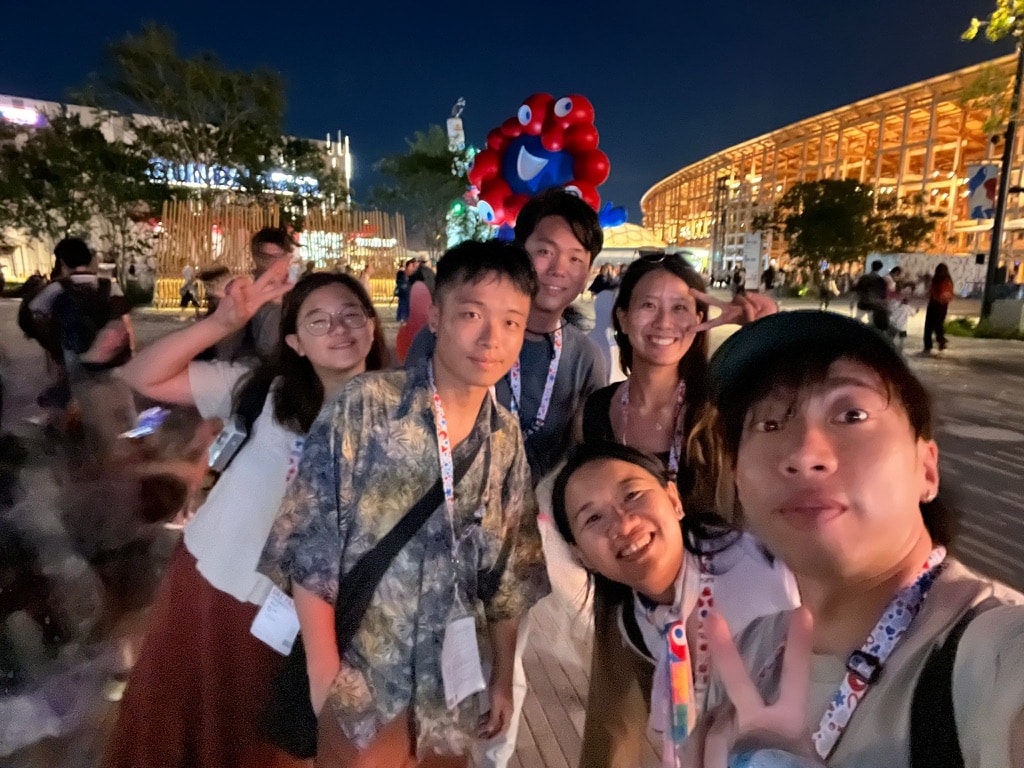
When many people think of a World Expo, they picture grand pavilions, displays of cultures from around the world, and lively crowds. For the VolTra Cultural Facilitators who headed to Expo 2025 Osaka this summer, the journey was never just about visiting or sightseeing. It was about placing themselves in an international setting and engaging in real dialogue with the world.
They didn’t come as tourists. They came as participants, standing inside the pavilion, interacting with visitors from around the globe, leading experiences, and handling situations as they arose. In this process, culture was no longer something to be observed but something to be practiced, and exchange was no longer just conversation but something that happened through the body, emotion, and creativity.
In this collaboration between VolTra and the Hong Kong Expressive Arts Therapy Service Centre (HKEXAT), our Cultural Facilitators used visual arts and movement to guide theatre experiences, interactive exhibitions, and community workshops within the pavilion. These activities had no set procedures or right answers for how the experience should unfold. Every interaction depended on the participants, languages, emotions, and cultural backgrounds in the moment.
It was precisely this absence of predetermined answers that made the journey so authentic.
“We thought we were ready when we departed, only to realize it was only the beginning of our service journey”
Before arriving in Osaka, the Cultural Facilitators had already completed a series of training sessions in Hong Kong, from expressive arts workshops to service design and leadership training. Each stage was designed to prepare them to stand firm on the international stage.
The training was not easy. It asked participants to go beyond “learning techniques” and gain deeper insights into themselves: how they express emotion, how they observe others, and where they fit within a team. Many might assume that having well-prepared content is enough for international exchange, but the real difficulty is often not what to say but how to respond to uncertainties.
When you meet participants from different cultural backgrounds, language may not be shared and understanding may not align. What you need is not just knowledge, but cultural sensitivity and the ability to be flexible.
The training didn’t make everything easy. But it helped participants understand that before stepping onto the international stage, the thing you most need to prepare is yourself.
The Real Challenge – Improvising with People
Once they entered the Expo pavilion, everything felt different.
It was no longer a classroom where things could be rehearsed, but a fast-changing space. Visitors came from many countries, each with different cultural backgrounds, language abilities, and emotional states. Some joined in eagerly, some kept their distance, some were full of curiosity, and some arrived carrying stories of their own.
The Cultural Facilitators’ job was not only to lead activities but to read the room.
Taking turns as Cultural Facilitators, they supported HKEXAT in promoting emotional well-being and self-awareness, using art to help participants open up. But this was not a one-way process; it was a two-way exchange. Sometimes a simple gesture, a drawing, or a moment of movement could forge a connection between strangers. At other times, though, cultural differences led to misunderstanding and distance.
In these moments, what was truly tested was not technique but judgment.
Henry’s reflection captures this well: “We were able to ease the tense atmosphere thanks to our communication skills and structured thinking, which allowed us to coordinate different stakeholders.” Behind these words lies the pressure of the moment. When the atmosphere grows tense and everyone has different expectations, you can’t step back, and you don’t have time to think it over. You can only improvise right then.
No classroom can fully simulate this kind of experience.
When Cultural Differences Became a Lived Experience
Many people say international exchange “broadens horizons.” But when you are actually in it, you discover that cultural difference is not an abstract concept; it is something that happens around you every single day.
Language differences make communication incomplete. Cultural differences give the same behaviour different meanings. Even the understanding of what “participation” means varies from person to person. Some participants are used to expressing themselves openly, while others need time to open up gradually.
In this environment, Cultural Facilitators learned not only how to express themselves but also how to help the other person feel seen.
Spencer put it plainly: “This experience made us think from different perspectives, and everyone was willing to go the extra mile to do their best together.”
In a cross-cultural setting, staying within your own understanding makes it easy to get stuck. Only when everyone is willing to go a step further, to try to understand and adapt themselves to the environment and people around them, can things keep moving forward.
This process can be exhausting and can even make you doubt yourself. But it is exactly in these moments that people begin to grasp the true weight of “culture.”
Teamwork, Responsibility, and Leadership
This journey was not only about personal growth; it was also a story about teamwork.
At the Expo, Cultural Facilitators didn’t simply complete tasks on their own. They had to support and coordinate with one another, and even make decisions together when unexpected situations arose. This kind of collaboration goes beyond dividing up the work; it means sharing responsibility.
When you know your performance affects the whole team, and when you realize some decisions can’t be made for yourself alone but must consider the group, the way you think begins to change.
This experience also lays the groundwork for their future roles leading overseas volunteer camps.
Leading is not just organising activities. It means making judgments amid uncertainty, finding balance among different voices, and staying clear-headed under pressure. These abilities aren’t built in a day; they accumulate through one real experience after another.
Expo 2025 Osaka proved to be just such a training ground.
Make a Real Impact with VolTra!
If you care about youth development, community restoration, and sustainability, we’d love you to explore VolTra’s local projects in Hong Kong. Through partnerships and hands-on practice, we want more young changemakers to learn in real-life contexts, and more communities to be seen, connected, and supported.
Want to know more about our local projects? Follow the link below to find out more!