

An Entry Pass to World Citizenship
When many people hear “going to Paris,” they think of the Eiffel Tower, cafés, museums, and romantic streets. But what I brought back this time is not a typical travel reflection, nor a city diary about sights and food. The purpose of this trip was to take part in a CCIVS Youth Committee meeting, where I joined the technical team and youth committee members from different regions to discuss the future of international volunteering, including youth participation, skills certification, connections with UNESCO, and the structure of a Working Team.
For many people preparing to join an international workcamp, this kind of experience may feel unfamiliar. What they imagine is probably a group of volunteers from different countries working in a community, cooking together, living together, and dealing with language and cultural differences. But the real impact of a workcamp often goes beyond those one or two weeks of service. When a young person begins to understand how the international volunteer network works, and starts to speak up on a global platform for their city, region, and culture, the meaning of volunteer travel – the idea at the heart of VolTra – keeps extending. This time I didn’t walk into Paris as a tourist. I entered a larger international conversation as a Hong Kong youth, an Asian representative, and a Youth Committee member. What I faced was not a checklist of photo spots but a great many meetings, documents, structures, strategies, divisions of work, and cross-cultural collaboration. This is the most honest side of international volunteering: it can be fun and it can build friendships, but it also requires commitment, patience, initiative, and responsibility.
The first reality check of this journey actually came before I left. As I mentioned in my sharing session, when I learned I was going to Paris for the meeting, I still didn’t have a clear picture of the arrangements. Until the end of February, I hadn’t received a clear schedule, and quite a few people around me asked, “So what does the whole run-down actually look like?” But the answer didn’t always come right away. For someone used to Hong Kong’s pace, that uncertainty can be unsettling. We all want a clear itinerary, meeting goals written down in advance, and a day-by-day plan we can grasp beforehand. But the reality of international cooperation is often different. When different regions, organizations, and teams work together, many things have to be discussed, coordinated, and agreed on as you go. This is not a tour group or a class presentation. It is an international youth collaboration platform that is still taking shape.
I had expected the meeting content to be fairly general and not necessarily produce very concrete results. But once it began, I found everyone deeply engaged. On the very first day, many people spoke up with questions and ideas, and they were willing to adapt to one another’s pace. That process of moving from “uncertain” to “figuring things out together” is exactly the most important lesson for young people joining international networks. Often, being a global citizen doesn’t mean waiting until every condition is in place before showing up. It means being willing to sit down, listen, ask questions, and organize your thoughts, and then offer your own perspective, even when you haven’t got the full picture yet. This matters just as much for anyone preparing for an international workcamp. Overseas volunteer work doesn’t always come with clear answers at every moment. Sometimes the work changes depending on the weather, community needs, or local arrangements. Sometimes you have to adjust first before you gradually find out how you lend a helping hand. What I encountered in Paris wasn’t physical labor but another kind of challenge: staying engaged amid ambiguity and building direction out of the unknown.
Am I Going to Fit in?
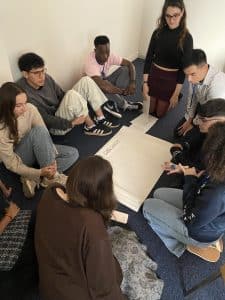
Beyond the meeting content, what worried me most at the start was whether I could fit in with this international youth group. To be honest, I said, “At the start I was a bit worried I wouldn’t really fit in with them.” That is a very real feeling, and an easy one to relate to. Many Hong Kong young people feel the same way the first time they join an international workcamp, conference, or overseas exchange. Is my English good enough? Will I know how to join the conversation? Does everyone already know each other? Will I end up just standing on the sidelines?
These worries don’t usually appear on promotional posters, but they are real. International exchange is not as simple as “meeting foreign friends.” Once you step into a truly diverse cultural space, you find that everyone has a different way of expressing themselves, a different sense of humor, different background knowledge, and different social habits. You need to observe, and you also need to take the initiative. You need to listen, and you also need to summon the courage to speak.
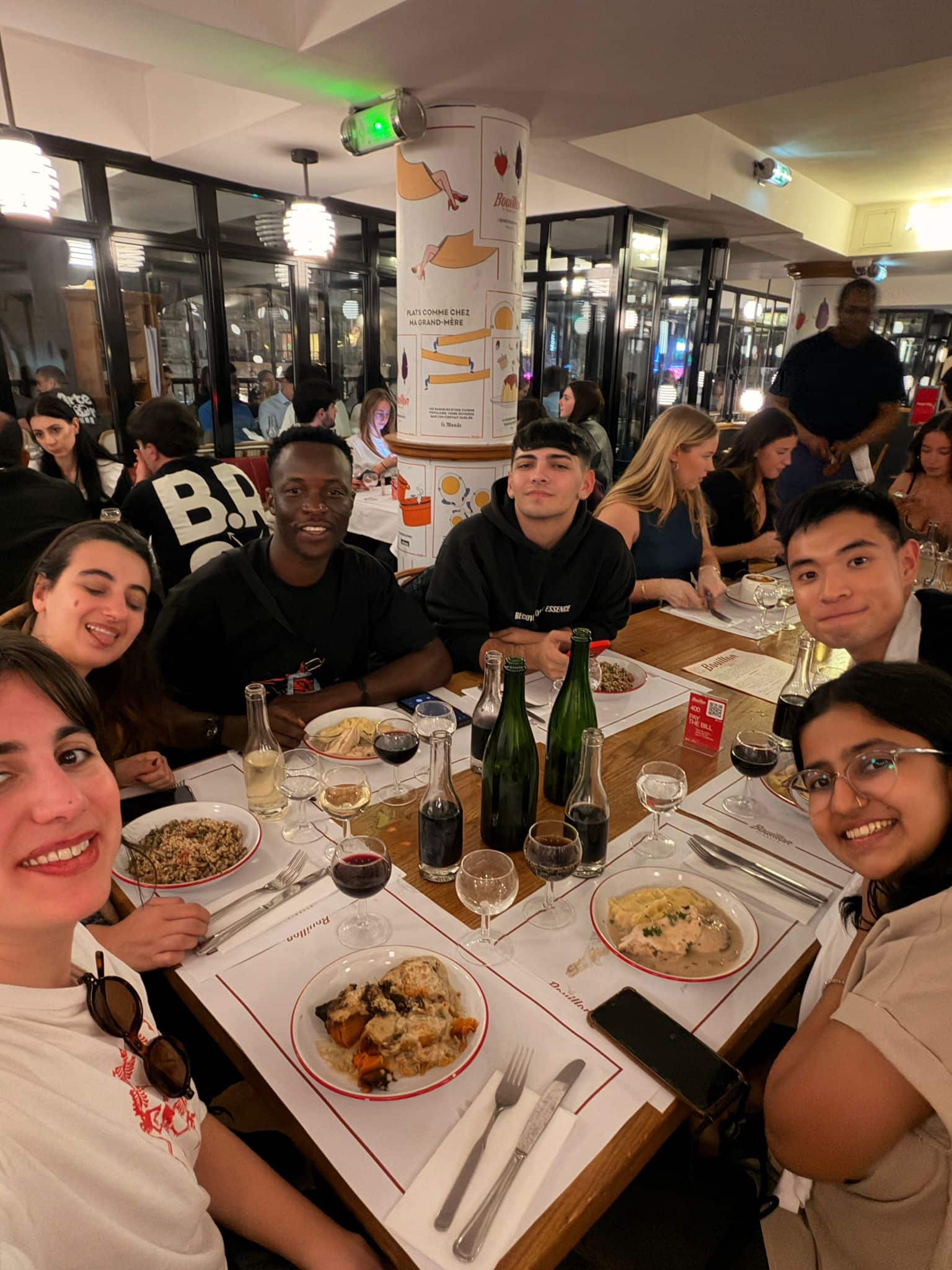
To my surprise, that unease was broken quickly. I remember that everyone was happy to chat on the first day, and on the second day we went out together for fun and meals, and the distance between us gradually closed. I described it as feeling “already well integrated into their group on the first day.” That wasn’t because my nerves suddenly vanished. It was because I found my own way to connect.
One fun detail was karaoke. When people brought up singing, I realized I could bring Asian and Hong Kong karaoke culture into the conversation. I had been to Paris several times before, so I naturally took everyone out to eat and to sing, building relationships outside the meetings. These things may look “peripheral”, but they are not peripheral at all. International cooperation doesn’t happen only at the meeting table. Much of the trust, rapport, and curiosity is built slowly over dinners, walks, songs, and everyday time together.
The birth of a Working Team
One important outcome of this Paris meeting was that the Youth Committee began to design the structure of a Working Team. The CCIVS Youth Committee I took part in is not just a youth exchange group. It is a platform that lets young people from different regions help shape the direction of international volunteering. Members came from different countries and regions, including France, the UK, Germany, Africa, Colombia, Argentina, Poland, and Peru. We usually meet only on Zoom, but this time we finally got to sit around the same table and bring our local experiences and perspectives into the discussion.
During the discussions, young people from different regions brought very different viewpoints. For example, one member raised experiences of street-based education in Latin America, and another stressed that community skills should not be valued less than school certificates. These conversations made me feel more deeply that taking part in international volunteering goes beyond “participation in an activity.” It is also about how a person lives, cooperates, and understands differences in an unfamiliar setting, and even how they turn local wisdom into a language the whole world can understand.
As a CCIVS Youth Committee member, my role is not just to attend meetings but to gather, organize, and summarize the opinions of other committee members, so the technical team can truly hear young people’s own voices as it designs the certification system and related outreach. This process helped me see that behind every certificate lie many cultural collisions, value negotiations, and acts of co-creation.
I mentioned many times in my sharing that the Working Team is different from the existing Working Group. It isn’t simply a matter of opening more chat groups. The idea is to create a clearer division of responsibilities for committee members, so that everyone can contribute according to their strengths, interests, and influence.
This part may sound like a work meeting, but it is actually very close to the Action Learning that VolTra has always believed in. At an international workcamp, people may learn through community cleanups, repairs, teaching, environmental work, or cultural exchange. In Paris, I was working on another kind of service: turning young people’s experience into systems, frameworks, and lasting opportunities to take part. This kind of work doesn’t earn instant applause, and it may not be “instagrammable”, but it can shape how many more young people enter this platform in the future.
Speaking for Hong Kong in a Europe-Centered Discussion
Another thing that stood out for me at this meeting was realizing my role as an Asian youth and a representative of Hong Kong. Most Youth Committee members came from Europe or other regions, and many initiatives were also Europe-centered. When people discussed skills certification, recognition frameworks, or pilot schemes, Asia’s participation and circumstances weren’t always at the forefront.
This isn’t only geographic distance. It is also a disparity of resources and systems. In the discussions, some noted that because of funding or program restrictions, certain initiatives find it harder to include Asian participants directly. I also noticed that although others would ask for Asian opinions, the overall direction still rarely brought up Asia on its own initiative. Frankly, everyone realized there were “funding limits,” and those limits do affect whether young people from different regions can take part. But limits don’t mean silence. Precisely because Asian voices were fewer, I felt I could offer more input. I said I had the chance to “represent Hong Kong and share some Asian perspectives,” including Hong Kong and Asian culture, as well as experiences with Asian workshops and cultural exchange. To my surprise, the other members were genuinely interested in Hong Kong and Asia and kept asking me to share more.
This is a small but important shift. We often assume that because we come from a small city, we may not have much to say in international settings, or that only large organizations in Europe and the Americas have the standing to define the direction of international volunteering. But this experience reminded me that Hong Kong youth are not bystanders. Our local experience, Asian networks, cultural observations, language skills, and workcamp stories can all be part of the international conversation. This matters especially for Hong Kong young people preparing for an international workcamp. Before you go, you may be busy sorting out flights, insurance, your backpack, and pre-camp materials. But there is something more important to prepare: how will you introduce Hong Kong? How do you understand your own culture? How will you bring your local experience to the international community? If all we can say is that Hong Kong has great food, shopping malls, and a night view, the exchange will stay on the surface. If we are willing to share Hong Kong’s communities, youth situation, volunteer experiences, and cultural contradictions, the world will get a much fuller picture of us.
Karaoke, Meals, and Real Friendship
The part of this Paris trip that is easiest to overlook, and also the warmest, is the time spent together outside the formal meetings. During my sharing session, my VolTra colleagues also pointed out that these side stories are worth recording. An international committee term may last only two years, so chances to meet face to face are few. If we keep only the meeting minutes and don’t record how everyone built friendships, a very important piece of the story goes missing.
My Paris was not only a meeting room. It was also eating together, going out together, and singing karaoke together. These moments may seem casual, but they are the foundation that lets an international network last. If people are connected only by an agenda, it is easy for everyone to drift back to where they started once the meeting ends. On the other hand, when you have looked for restaurants together in an unfamiliar city, sung together, and shared your cultures with one another, cooperation is no longer just contact between organizations. It lays the foundation of trust between people.
This also echoes what is most captivating about international workcamps. What stays with participants is often not any one task but how people build relationships between work and life. You learn to compromise while cooking together, to express yourself in discussions, to look out for each other when you get lost, and when you say goodbye, you realize that just those few days have left a deep bond.
The Paris meeting was not a workcamp, but it sent the same message as a workcamp: service and exchange never happen only in formal sessions.
This is also a reminder for readers who imagine that international exchange must be easy. Cross-cultural friendship doesn’t appear automatically. It requires you to step out of your comfort zone. You may have to be the first to invite someone, explain your culture in imperfect English, or have a moment when you don’t know how to respond. But once you take that step, the international network stops being an abstract term and becomes a map made of real faces.
Beyond the Workcamp
One important takeaway from this meeting for me and the VolTra team was how to document the experience so that more Hong Kong young people can understand what is happening in the international network. After the meeting, we talked about the importance of experience capture. For someone who has never been involved in an international volunteer network, terms like international cooperation, council, and committee feel very distant. Without concrete stories, it is hard to imagine how one can keep taking part after a workcamp.
So documenting is itself a form of action. Writing my Paris experience as a blog post isn’t just about promoting an overseas trip. It is about letting more people see that an international workcamp is not a one-time event. You can start as a participant and gradually become a youth leader, a speaker, a committee member, and even take part in building the structure of an international platform. Just start from one service project and go on to think about skills recognition, youth empowerment, funding, communication, and glocal connection. You don’t have to stop at having “been there.” You can bring what you learned back to Hong Kong and turn it into more opportunities for others.
This is the growth journey of a global citizen. A global citizen is not someone with many stamps in a passport. A global citizen is someone who wants to understand how the world is connected, who is willing to place themselves in a larger context, and who is ready to contribute to shared change.
For Hong Kong youth, university students, or working professionals thinking about a gap year or using their annual leave for a deeper experience, my story may offer a different angle. You don’t need to start with great confidence, or be familiar with every international issue, or feel you can represent anyone. You can just begin with an international workcamp, learning to work with others, to live in unfamiliar places, and to understand what a community really needs. Then, when you’re ready, you can carry that experience to a larger international platform and let Hong Kong’s and Asia’s voices be heard.
It’s Not All Sunshine and Rainbows
At a typical workcamp, challenges might come from simple living conditions, language differences, cooking together, physical labor, culture shock, or spending long stretches with strangers. In my Paris experience, the challenges came at another level: the schedule wasn’t clear at first, discussions didn’t always have immediate answers, international cooperation is limited by resources, Asian voices have to be actively claimed, and youth participation needs to be gradually turned from enthusiasm into structure. None of this is postcard-perfect, but precisely because it is real, it helps you grow.
The most valuable thing about international volunteering has never been a short escape from Hong Kong. It is coming back with fresh eyes. You start to ask: where does Hong Kong sit in the world’s networks? How can Asian youth take part in global discussions? Can my volunteer experience turn into longer-term action? Can I do more than join activities, and help create platforms that many more people can join?
The meaning of this journey isn’t only that I went to Paris, walked into UNESCO, or met youth partners from different places. More importantly, at that international table I saw that I could share perspectives on behalf of Hong Kong and Asia, and I saw that there is still much about international volunteering that needs young people to help improve. Going from worrying about not fitting in to taking everyone out for karaoke, sharing Hong Kong culture, and joining the discussion on the Working Team structure was a journey of growth from unease to initiative, and from participation to responsibility.
If you also long for a trip that is not just for a break or for photos, an international workcamp may be a good place to start. It may not be comfortable, it may not go smoothly every moment, and it may not always come with clear answers. But it will help you know yourself better, understand the world more, and see how you can find your place in Glocal Action. When you are willing to step out of your comfort zone, you’ll find the world isn’t a distant concept. It is a real group of volunteers who are willing to work, learn, and change things together.
Make a Real Impact with VolTra!
If you care about youth development, community restoration, and sustainability, we’d love you to explore VolTra’s local projects in Hong Kong. Through partnerships and hands-on practice, we want more young changemakers to learn in real-life contexts, and more communities to be seen, connected, and supported.
Want to know more about our local projects? Follow the link below to find out more!