

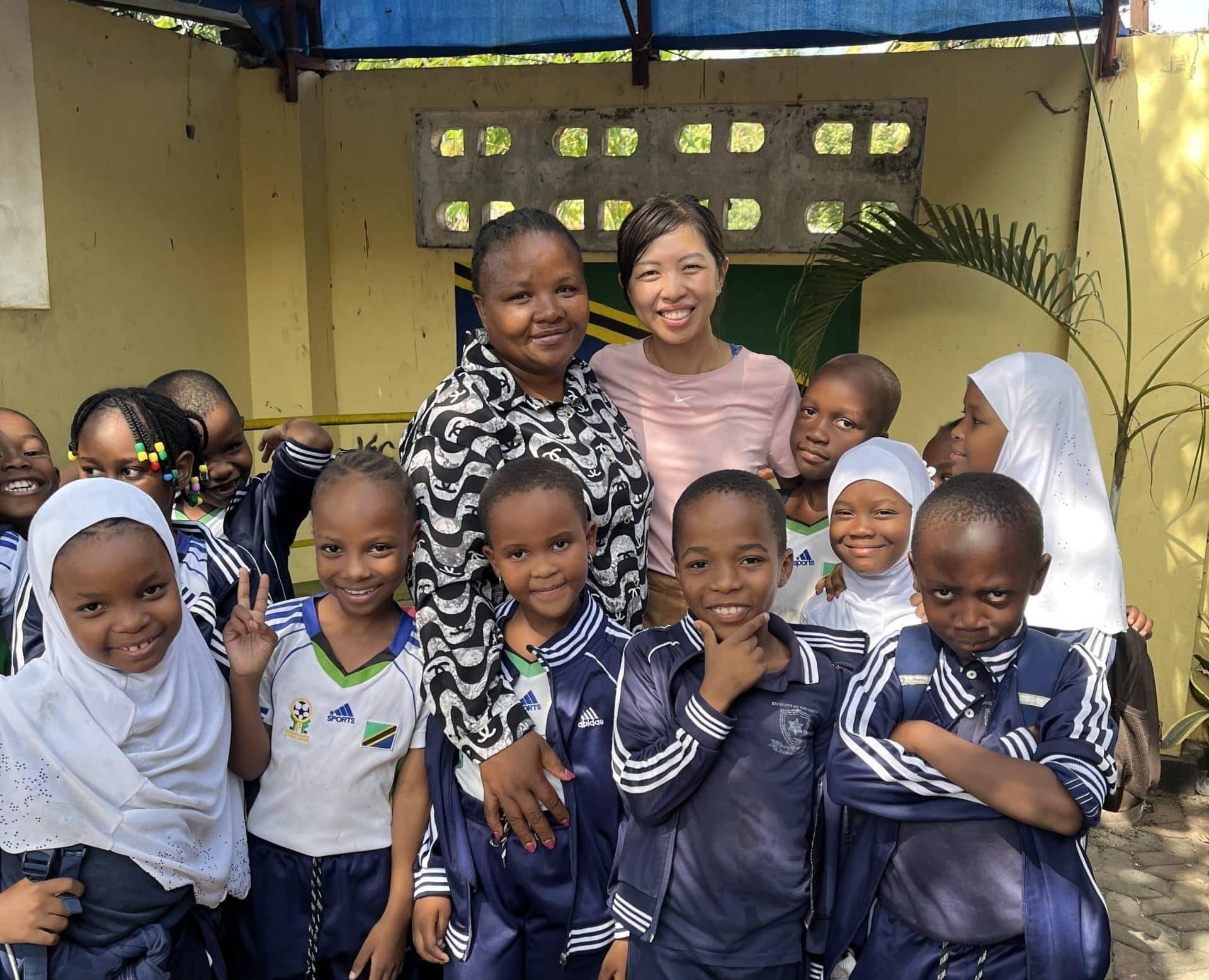
I wanted to go somewhere farther, and stay longer
My reason for choosing Tanzania was actually quite simple. I wanted to go to an African country and spend a longer period of time truly experiencing local life.
At first, I had signed up for a more common type of volunteer camp, one focused on children’s services. But I have always been more interested in environmental issues, so I asked my VolTra colleagues whether there were any workcamps related to the environment or sustainability. At the time, information on these projects wasn’t fully available online. With the help of my VolTra colleagues, who contacted and confirmed details with local organizations, I learned that Tanzania had a longer-term project with a theme much closer to environmental protection. So I switched camps and postponed my departure.
Looking back, I’m really glad I asked that extra question. Every choice and action we make reflects how we want to engage with the world and what kind of life we want to build. For me, I didn’t want to just drop by as a visitor. I wanted to experience a living environment very different from Hong Kong, and to see how local people deal with resources, the environment, culture, and a completely different daily rhythm. The Tanzania workcamp gave me exactly that opportunity.
I went to Tanzania at the end of September 2025. Compared with short camps of eight or ten days, this one lasted three weeks, long enough for me to settle in and experience local life rather than simply passing through. That mattered to me. In some places, if you only skim the surface, you’ll remember only blurry scenery and impressions. But if you stay a little longer, you begin to see deeper things: the logic of local life, the relationship with the community, the place of faith in everyday life, and how you yourself react when facing an unfamiliar environment.
Many people imagine overseas volunteering as a kind of “meaningful travel,” where you can serve and explore at the same time, which sounds fulfilling and ideal. But for me, what was truly valuable about this Tanzania workcamp was not just the tasks I completed. It let me gain a deeper understanding of a completely different world, learn to let go of my familiar way of life, and understand life from the perspective of local people. This is also something I became increasingly sure of: an international workcamp is not just about “going to help people.” Often, you are first re-educated by a place, and only then slowly learn how to take part in it.
In Tanzania, I didn’t stay in a typical volunteer dormitory. I lived with a host family. In other words, I wasn’t living with a group of international volunteers. I shared living space with a local family and went about daily life alongside them. The village where I stayed is called an “eco village,” located in a suburban area. The surroundings were peaceful and tranquil. There was more space than in the city, with animals and farmland all around and an open landscape. You don’t feel the density and speed of Hong Kong. Instead, there is a life close to the land, a simple lifestyle that feels ideal. But once you actually live there, you come to experience the inconveniences that simple living brings.
When water and power cuts become routine

In terms of facilities and supplies, the place was very different from Hong Kong. Water and power cuts happened, and not every basic supply was stable. Daily necessities were simple, and you couldn’t judge them by Hong Kong’s “anything you want is available” standard. Many things we take for granted in Hong Kong are not necessarily available there. Adapting to these conditions naturally took time at first. Even though I had told myself before departure that it would be very different from Hong Kong, once I entered that environment, my body and mind still needed time to adjust.
Perhaps because of this simplicity, though, I felt a kind of sincerity that rarely appears in cities. When material supply is not unlimited and the pace of life is not driven by efficiency, you start to see anew the environment, resources, and the relationships between people. I began to understand how the place worked and how people lived.
Although I stayed for three weeks, I didn’t spend a great deal of time with my hosts every day. They were working people who were out at their jobs during the day, so often it was only in the evening that we really met, ate together, and chatted. My volunteer activities were mostly carried out within the village, with occasional rides to a youth center to serve there, so I spent most of my time inside the eco village.
This arrangement might not sound like an “activity-filled” experiential trip, but what it gave me was a very real immersion in daily life. You don’t enter as a tourist, and you aren’t taken around to see sights. You simply live in the same place, observe how others spend each day, and let yourself readjust to that pace. I think this is what makes a homestay and a mid-length volunteer camp so different. You don’t just see a fragment of Tanzania. You temporarily move into its rhythm.
Religion, neighbors, and daily life: the atmosphere of a place is shaped by the distance between people
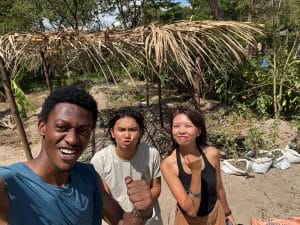
During my three weeks there, one of my deepest impressions was how much Tanzanians value faith and connection between people.
Religion in their lives is not an abstract identity label. It is woven concretely into daily life. The neighbors I met included Muslims and Christians, and even within a single family, people might attend different churches. I found this fascinating, because it shows that although faith is very important, there is more than one way to practice it. What impressed me even more was how much time they genuinely devote to religious life. Church services last a long time, and after returning home they continue to watch religious programs so that faith stays present in their lives. Some neighbors pray frequently, and devotion is one of the foundations of their lives.
For me, this was a major cultural experience. In Hong Kong, we may not see religion as the main thread of everyday life, but there it is clearly an order of values and a way of connecting the community. You can feel that many people’s lives are supported by belief, family, and community. This doesn’t mean they have no real-life pressures, but there is an important place in their lives reserved for faith.
Besides religion, another thing that moved me was how little distance there is between neighbors. Everyday interactions in the village reflected closer relationships. Because it is not a highly urbanized, densely populated environment, the sense of community is also stronger. People seem to retain an older, more direct kind of warmth. They greet you when they see you and chat for a long time, unlike Hong Kong, where everyone is busy with their own pace.
This warmth was deeply meaningful to me, not because it was dramatic, but because it was so ordinary. It was precisely those seemingly plain greetings, relaxed conversations, and the sense of familiarity within the community that gradually shaped my understanding of the place. You discover that the atmosphere of a place is not necessarily determined by its buildings or attractions. Often it is determined by the distance between people.
This also helped me understand that cultural exchange means learning to live in the other person’s way. Only when you actually live there do you realize that what is most different about a place is often not its surface-level exoticism, but how it views relationships, time, and living together.
Building a herb garden from scratch: you don’t need to know everything to begin
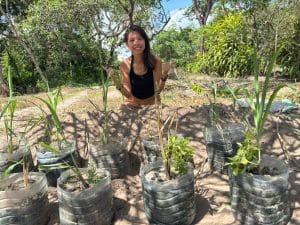
During these three weeks, I had three main tasks. The first, which I found the most exhausting but also the most rewarding, was building a herb garden from scratch within the eco village.
The local climate is fairly dry, and herbs are not a common ingredient there. However, the local organization wanted to promote the idea of growing your own food rather than buying everything from markets or supermarkets. So we took an empty plot in the village, with no facilities at all, and built the herb garden step by step.
It sounds simple, but it was not easy to do. We had to turn the soil, build a shelter, make compost, dig holes, and transplant herb seedlings. The whole process was not only physical labor but also constant problem-solving. We had almost no materials to work with, so we had to think as we went and see what could be sourced locally. How could the herb garden keep going in any weather? How could we store water? How should the shade structure be built so it wouldn’t collapse?
Volunteering can mean learning as you go
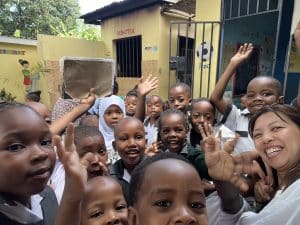
The most interesting part was that none of us volunteers really knew how to do it at the beginning. There were only three of us, and none of us were gardening experts, so we searched online, asked AI, and discussed with local people as we worked. This was special to me because it completely overturned the idea that “volunteering means contributing something you already know how to do.” Often you are learning from zero, even learning while doing, and slowly finding a way through uncertainty.
What struck me most about the herb garden was not just that it was finally built, but that the whole process brought me closer to the logic of the natural environment. For example, we checked whether the land had enough moisture and looked at what materials were nearby. We broke larger stones into smaller gravel and laid it in the holes we had dug. These materials weren’t bought from a hardware store. They came directly from the local environment. You clearly feel that people are not designing in a space of unlimited resources, but negotiating with the environment within existing conditions.
When it was finished, the sense of satisfaction was very real. It wasn’t a plan on paper. It was something we made slowly with our own hands. It may not be perfect, and there is no guarantee that every plant will grow well, but going from nothing to something showed me, for the first time in a very concrete way, that limited resources can push you to think more seriously about what sustainability means and how to truly make good use of the environment.
Environmental work is not a slogan. It means going into the smelliest, most uncomfortable places
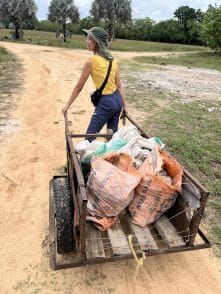
Besides the herb garden, my second task was running workshops at schools on environmental themes. The topic I ended up presenting was climate change. This was meaningful to me because it directly echoed my reason for switching camps in the first place: I joined this project because I was interested in environmental issues.
However, the most shocking experience came from the third task, which involved avocado seeds. The local organization wanted to collect rotten, discarded avocados from the market, take the seeds back for processing, and then distribute them to partner schools so that students could plant them. The idea itself was very meaningful, as it tried to turn waste back into a renewable resource. But when you actually arrive on site, you realize it is neither a clean nor an easy task.
The rotten avocados were not waiting for us in a tidy, hygienic recycling station. They were in an open area behind the market that looked like a landfill. All the market vendors dump rotting fruit, vegetables, and other trash there, and the whole scene was overwhelming. First, the smell was so bad that you hardly dared to get close. Second, there were hygiene concerns, and you could imagine rats and insects scurrying about. Although we had basic protective gloves and masks, it was still not a reassuring environment.
When environmental work takes you to a landfill-like site
In the end, the other two volunteers went straight into the pile of trash to pick out seeds, while I took on the job of washing the seeds, cleaning off the pulp stuck to them. Even though I was only washing and didn’t have to go into the landfill itself, just seeing bags of rotten avocados and smelling that nauseating odor was a direct shock.
But precisely because of this, I came to understand “environmental protection” very differently. In Hong Kong, it is easy to keep environmentalism at the level of ideas, slogans, educational activities, or seemingly well-organized recycling systems. But in Tanzania, I saw that environmental work means going into the smelliest, messiest, least ideal places, facing waste in its rawest form, and asking: is there anything in here that can still be reused? Is there anything worth bringing back into the cycle of life?
This kind of experience is not romantic, but it is real. It taught me that environmentalism is not just talking about sustainability from a clean place. It is about whether you are willing to get close to the realities we normally most want to avoid. Only when you are willing to enter the scene do you find out how close resources, waste, and renewal really are.
Managing expectations: you’re not there to replicate Hong Kong, but to learn another attitude toward life
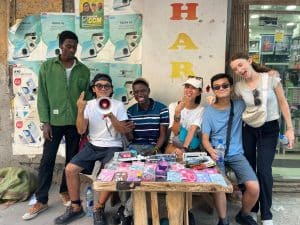
If I were to give advice to anyone who wants to join the Tanzania workcamp, I think the most important thing is not what gear to bring, but what mindset to set out with.
The first thing is to allow time to adapt. Even if you know beforehand that the local environment will be very different from Hong Kong, once you are actually in a life without stable running water, where power may go out and supplies are very basic, you still need time to adjust. This is especially true if you haven’t left a highly comfortable, smoothly running city rhythm for a long time, since both body and mind will react. For me, this adaptation did not happen in a day or two. You really need to give yourself a week, or even one to two weeks, to transition gradually. So if you join a shorter camp, you need to be even better mentally prepared. A short camp doesn’t mean fewer challenges. You may just be starting to adapt when the trip is almost over. With a longer camp, you can ease into that way of living more slowly and avoid demanding that everything go smoothly right away.
The second thing is not to judge everything there by Hong Kong’s standards. I think this is very important. Whether it’s how local people organize things, how they work, or things we are quick to be sensitive about, such as hygiene standards, the sense of time, and work processes, you must first remind yourself that this is a very different culture and environment. Hong Kong’s sense of order, efficiency, precision, and standardization is not the same everywhere in the world. If you compare everything with what you are used to, you will find it exhausting and easily get stuck. For example, many arrangements there may be more spontaneous, without the fixed and tightly planned schedules you might imagine. This doesn’t necessarily mean they aren’t serious. It means they live in a different way. You can compare, observe, and feel uncomfortable, but don’t rush to judge the whole situation as “bad” using familiar standards. After all, the purpose of coming is not to replicate Hong Kong, but to experience a different attitude toward life.
The world has never had just one way of working
I actually think one of the most important lessons of an international workcamp is that you gradually come to understand that the world is not entirely fair, and that it doesn’t have only one way of operating. Not every place values immediacy, convenience, and efficiency as Hong Kong does, but that doesn’t mean other people’s lives lack logic, or that their rhythm lacks value. Often, it is precisely because you have temporarily left the system you know that you begin to reflect on things you have always taken for granted.
So if you ask me whether the Tanzania workcamp is worth going to, I would say: it is not a comfortable trip, nor one where everything adapts to your habits. You will encounter inadequate facilities, a different pace, work sites harder than you imagined, and situations you are unsure you can handle. But if you are willing to stay flexible, set judgment aside for a while, and walk in as a learner, what you gain will often be more than you expected.
You thought you were going to do environmental work, but first you learned humility and gratitude
Looking back, the deepest takeaway from this Tanzania workcamp may not be what I did, but how I was changed.
I went because I wanted to engage with environmental issues, and I did take part in plenty of work related to sustainable living. These tasks were very concrete and close to what I was originally interested in. But what stayed with me was not just the tasks themselves, but the very real sense of being on site behind them. You come to see that environmental protection is not a concept. It is a reality in which land, water, tools, physical effort, climate, resource use, and passing things down are all intertwined.
At the same time, my time in the eco village showed me more deeply how far a place’s way of life can be from Hong Kong’s. Not that one is better than the other, but I came to understand that there really are people in this world who live steadily and sincerely despite water and power cuts and simple supplies. There really are places where relationships between people can still be so close. Religious faith can truly occupy such a big place in daily life. And the conveniences we are used to are not necessarily basic conditions everywhere.
When you experience all this firsthand, it is hard not to become humble and grateful. You begin to realize that many of your past judgments were too quick and too taken for granted. You thought you were going to help, to give, to do something meaningful, but in the end, the one whose eyes were opened first was yourself.
I think this is the most precious thing about international workcamps. They may not give you a comfortable journey, nor make every day feel full of achievement. But they place you in a real place where you learn, clash, adapt, and reflect. Those processes may not be glamorous, but they often leave the deepest mark. I learned how to live in an unfamiliar environment, how to coexist with difference, and how to rethink the relationship between people, land, and the world in a place with limited resources.
If you are also considering joining an international workcamp, I would like to say: please don’t treat it merely as an “alternative trip.” It will certainly take you far away, but more importantly, it will let you see, in a very down-to-earth way, how another place lives, and how much room you still have to learn. And when you are willing to step away for a while from a life where “anything you want is available,” you may slowly come to understand that what truly changes the way we see the world is never the most comfortable experiences. It is the moments that force us to rethink what life is, what resources are, and what it means to live alongside the world.
Want to make a difference while exploring the world?
Interested in the details of our projects (dates, fees, application process)? Visit the links below!